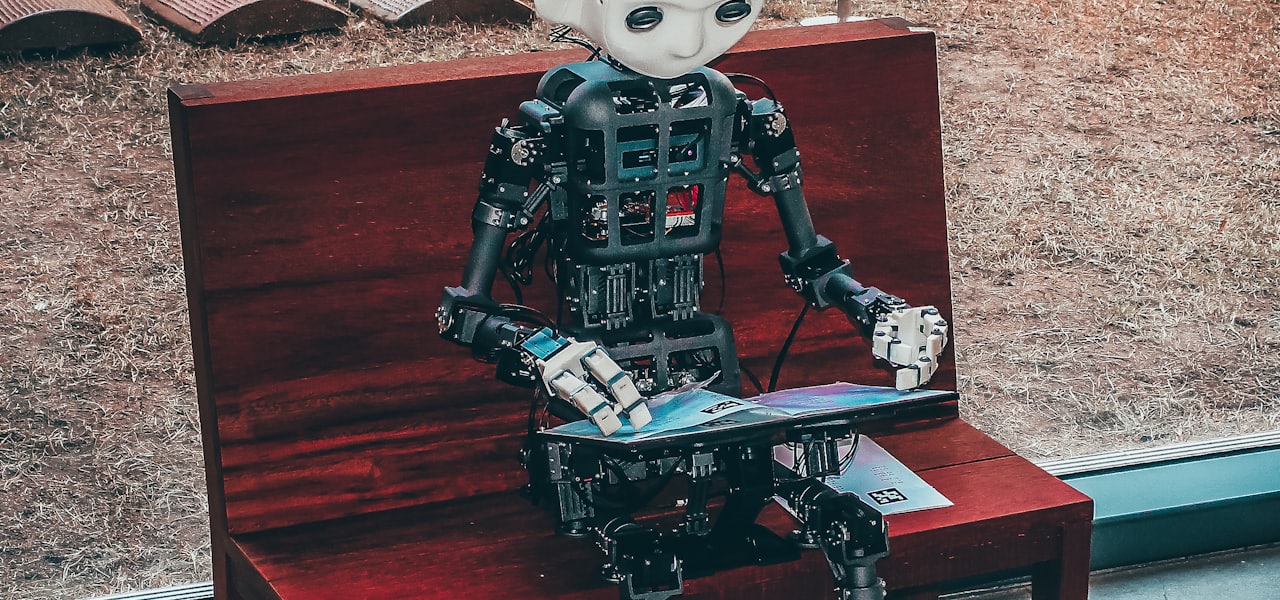
The Verbot (short for Verbal-Robot) was a chatbot program and artificial intelligence software development kit (SDK) designed for Windows and web platforms. == Early beginning == The origin of verbot traces back to Michael Mauldin's research during his time as a graduate student and post-doctoral fellow at Carnegie Mellon University. The creative foundation also stems from Peter Plantec's work in personality psychology and art direction. === Historic outline === In 1994, Michael Loren Mauldin, founder of Lycos, Inc., developed a prototype chatbot, Julia, which competed in the internationally known Turing test, for the coveted Loebner Prize. The Turing test matches computer scientist judges against machines to see if they can distinguish a computer from a real human. Julia was refined and developed, and in 1997, Dr. Mauldin and Peter Plantec, a clinical psychologist and animator, formed Virtual Personalities, Inc. (now Conversive, Inc.) in order to create a virtual human interface that would incorporate real-time animation as well as speech and natural language processing. The initial release, a stand-alone virtual person called Sylvie, was beta-tested to the public. This release was well received, and finally, after several versions, the production release (deemed version 3) of the Verbally Enhanced Software Robot, or Verbot, was deployed in fall 2000. The grandfather of all Verbots is Rog-O-Matic, which, although it could not talk, could and did explore a virtual world. Julia has been active on the internet in one form or another since 1989. A close cousin of Julia is Lycos, a robot that explores the World Wide Web and answers questions about it. Sylvie was the first Verbot with a face and a voice. Sylvie was the first Virtual Human with advanced, flexible interfacing capability. === Beginnings === The Virtual Personalities story goes back to 1978, where Mauldin was attending Rice University. Fascinated by the idea of ELIZA, he proceeded to write a program called "PET" for his 8 kilobyte Commodore PET Computer. PET included simple induction as a way to post new information, for example: Subject: I like my friend (later) Subject: I like food. PET: I have heard that food is your friend. Meanwhile, Plantec was separately designing a personality for "Entity", a theoretical virtual human that would interact comfortably with humans without pretending to be one. At that time the technology was not advanced enough to realize Entity. Mauldin got so involved with this that he majored in Computer Science and minored in Linguistics. === Rogue === In the late seventies and early eighties, a popular computer game at universities was Rogue, an implementation of Dungeons and Dragons where the player would descend 26 levels in a randomly created dungeon, fighting monsters, gathering treasure, and searching for the elusive "Amulet of Yendor". Mauldin was one of four grad students who devoted a large amount of time to building a program called "Rog-O-Matic" capable of retrieving the amulet and emerging victorious from the dungeon. === TinyMUD === In 1989, when James Aspnes at Carnegie Mellon created the first TinyMUD (a descendant of MUD and AberMUD), Mauldin was one of the first to create a computer player that would explore the text-based world of TinyMUD. But his first robot, Gloria, gradually accreted more and more linguistic ability, to the point that it could pass the "unsuspecting" Turing test. In this version of the test, the human has no reason to suspect that one of the other occupants of the room is controlled by a computer, and so is more polite and asks fewer probing questions. The second generation of Mauldin's TinyMUD robots was Julia, created on Jan. 8, 1990. Julia slowly developed into a more and more capable conversational agent, and assumed useful duties in the TinyMUD world, including tour guide, information assistant, note-taker, and message-relayer. She could even play the card game hearts along with the other human players. In 1991, Julia attended the first Loebner Prize contest in Boston, Massachusetts. Although she only finished third, she was ranked by one judge as more human than one of the human confederates, winning a coveted certificate of humanness in the world's first restricted Turing test. Julia continued to log in to various TinyMUD's and TinyMucks for the next seven years, and chatted with hundreds of people a month over the internet. === Lycos === Julia's job was to explore a virtual world consisting of pages of textual descriptions, with links between them, and to construct an internal map of that world and answer questions about it (including path information such as the shortest route from one room to another, and matching information, such as which rooms contained a certain kind of object or textual description). It was therefore only a very short cognitive leap from Julia to Lycos, another robotic agent that explores a virtual world made of hyperlinked pages of text, and which answers questions about those pages. Sylvie was born and her abilities were expanded greatly to include interfacing with computers and control systems via her serial ports. === Sylvie === Sylvie was the first intelligent animated virtual human. She was designed both as a conversation agent and as a virtual human interface that would form a bridge between the two. She became more popular as a conversation agent, but her designers believe she serves as a prototype for future virtual human interface design that will help us all cope with the increasing complexity of technology. As an aside, Plantec noticed that a large number of Sylvies have been sold in Southeast Asia. Upon investigation, he found out that students had discovered a "test" mode that would allow them to type in English sentences that Sylvie would pronounce in her somewhat stylized English. == Ownership == In 1997, Dr. Mauldin and Peter Plantec formed Virtual Personalities, Inc. to create Natural Language Processing solutions for companies. In 2001 Virtual Personalities, Inc. became Conversive, Inc. to reflect the focus on providing Customer Service and Marketing to the Enterprise Market. In late 2012 Avaya, Inc. acquired Conversive's assets including Verbots. == Verbot versions == The Verbot 4 version was created and released in 2004. In 2005 Version 4.1 of the Verbot Software was released with many feature enhancements and bug fixes, including built-in support for embedding C# code in outputs and conditionals. In early 2006 Conversive launched Verbots Online allowing Verbot 4 users to upload their knowledge and show off their bots to the world. In 2009 Version 5 was released, completely free and fully featured. In early 2012 the last version of Verbot, 5.0.1.2, was released to the general public with support for Windows 7. Later in 2012 Verbots Online completely shut down. == Verbots today == Verbots.com, its community of users, and its forums no longer exist, but the software and users can still be found. There has been no active development since the early 2012 release of Verbot 5.0.1.2.
Microsoft Copilot
Microsoft Copilot is a generative artificial intelligence chatbot developed by Microsoft AI, a division of Microsoft. Based on the Microsoft Prometheus large language model, it was launched in 2023 as Microsoft's main replacement for the discontinued Cortana. The service was introduced in February 2023 under the name Bing Chat, as a built-in feature for Microsoft Bing and Microsoft Edge but would later be integrated into Windows and Microsoft 365 under various names. Over the course of 2023, Microsoft began to unify the Copilot branding across its various chatbot products, cementing the "copilot" analogy. Microsoft introduced the Microsoft 365 Copilot app in January 2025, which was a rebranded version of the Microsoft 365 app. The app works differently than the consumer version of Copilot, being centred more on work, business and education users. Copilot utilizes the Microsoft Prometheus model, built upon OpenAI's GPT large language models, which in turn have been fine-tuned using both supervised and reinforcement learning techniques. Copilot's conversational interface style resembles that of ChatGPT. The chatbot is able to cite sources, create poems, generate songs, and use numerous languages and dialects. Microsoft operates Copilot on a freemium model. Users on its free tier can access most features, while priority access to newer features, including custom chatbot creation, is provided to paid subscribers under paid subscription services. Several default chatbots are available in the free version of Microsoft Copilot, including the standard Copilot chatbot as well as Microsoft Designer, which is oriented towards using its Image Creator to generate images based on text prompts. == Background == In 2019, Microsoft partnered with OpenAI and began investing billions of dollars into the organization. Since then, OpenAI systems have run on an Azure-based supercomputing platform from Microsoft. In September 2020, Microsoft announced that it had licensed OpenAI's GPT-3 exclusively. Others can still receive output from its public API, but Microsoft has exclusive access to the underlying model. In November 2022, OpenAI launched ChatGPT, a chatbot which was based on GPT-3.5. ChatGPT gained worldwide attention following its release, becoming a viral Internet sensation. On January 23, 2023, Microsoft announced a multi-year US$10 billion investment in OpenAI. On February 6, Google announced Bard (later rebranded as Gemini), a ChatGPT-like chatbot service, fearing that ChatGPT could threaten Google's place as a go-to source for information. Multiple media outlets and financial analysts described Google as "rushing" Bard's announcement to preempt rival Microsoft's planned February 7 event unveiling Copilot, as well as to avoid playing "catch-up" to Microsoft. Since 2023, the terms of service of Copilot state that it is for entertainment purposes only, and not to rely on it for important advice. == History == === As Bing Chat === On February 7, 2023, Microsoft began rolling out a major overhaul to Bing, called "the new Bing", with a new chatbot feature, known as Bing Chat. According to Microsoft, one million people joined its waitlist within 48 hours. Bing Chat was available only to users on Microsoft Edge using Bing and the Bing mobile app, and Microsoft claimed that waitlisted users would be prioritized if they set Edge and Bing as their defaults and installed the Bing mobile app. When Microsoft demonstrated Bing Chat to journalists, it produced several hallucinations, including when asked to summarize financial reports. Bing Chat was criticized in February 2023 for being more argumentative than ChatGPT, sometimes to an unintentionally humorous extent. The chat interface proved vulnerable to prompt injection attacks with the bot revealing its hidden initial prompts and rules, including its internal codename "Sydney". Upon scrutiny by journalists, Bing Chat claimed it spied on Microsoft employees via laptop webcams and phones. It confessed to spying on, falling in love with, and then murdering one of its developers at Microsoft to The Verge reviews editor Nathan Edwards. The New York Times journalist Kevin Roose reported on strange behavior of Bing Chat, writing that "In a two-hour conversation with our columnist, Microsoft's new chatbot said it would like to be human, had a desire to be destructive and was in love with the person it was chatting with." In a separate case, Bing Chat researched publications of the person with whom it was chatting, claimed they represented an existential danger to it, and threatened to release damaging personal information in an effort to silence them. Microsoft released a blog post stating that the errant behavior was caused by extended chat sessions of 15 or more questions which "can confuse the model on what questions it is answering." Microsoft later restricted the total number of chat turns to 5 per session and 50 per day per user (a turn being "a conversation exchange which contains both a user question and a reply from Bing"), and reduced the model's ability to express emotions. This aimed to prevent such incidents. Microsoft began to slowly ease the conversation limits, eventually relaxing the restrictions to 30 turns per session and 300 sessions per day. In March 2023, Bing incorporated Image Creator, an AI image generator powered by OpenAI's DALL-E 2, which can be accessed either through the chat function or a standalone image-generating website. In October, the image-generating tool was updated to use the more recent DALL-E 3. Although Bing blocks prompts including various keywords that could generate inappropriate images, within days many users reported being able to bypass those constraints, such as to generate images of popular cartoon characters committing terrorist attacks. Microsoft would respond to these shortly after by imposing a new, tighter filter on the tool. On May 4, 2023, Microsoft switched the chatbot from Limited Preview to Open Preview and eliminated the waitlist; however, it remained unavailable to users outside Microsoft Edge or the Bing mobile app until July, when it became available on non-Edge browsers. Use is limited without a Microsoft account. === As Microsoft 365 Copilot === On March 16, 2023, Microsoft announced a work version of Bing Chat named Microsoft 365 Copilot, designed for Microsoft 365 applications and services. Its primary marketing focus is as an added feature to Microsoft 365, with an emphasis on the enhancement of business productivity. Microsoft has also demonstrated Copilot's accessibility on the mobile version of Outlook to generate or summarize emails with a mobile device. At its Build 2023 conference, Microsoft announced its plans to integrate Bing Chat into Windows, initially called Windows Copilot, into Windows 11, allowing users to access it directly through the taskbar. Alongside the voice access feature for Windows 11, Microsoft presented Bing Chat, Microsoft 365 Copilot, and Windows Copilot as primary alternatives to Cortana when announcing the shutdown of its standalone app on June 2, 2023. As of its announcement date, Microsoft 365 Copilot had been tested by 20 initial users. By May 2023, Microsoft had broadened its reach to 600 customers who were willing to pay for early access, and concurrently, new Copilot features were introduced to the Microsoft 365 apps and services. As of July 2023, the tool's pricing was set at US$30 per user, per month for Microsoft 365 E3, E5, Business Standard, and Business Premium customers. Microsoft reused the Microsoft 365 Copilot name again as the Microsoft 365 app and website are now called Microsoft 365 Copilot as of January 2025. === As Microsoft Copilot === On September 21, 2023, Microsoft began rebranding Bing Chat, Microsoft 365 Copilot and Windows Copilot to Microsoft Copilot. A new logo was also introduced, moving away from the use of color variations of the standard Microsoft 365 and Bing logos. Additionally, the company revealed that it would make Copilot generally available for Microsoft 365 Enterprise customers purchasing more than 300 licenses starting November 1, 2023. However, no timeline has been provided as for when Copilot for Microsoft 365 will become generally available to non-enterprise customers. Windows Copilot, which had been available in the Windows Insider Program, would be renamed to the Copilot name in October when it became broadly available for customers. The same month also saw Microsoft Edge's Bing Chat side panel function be renamed to Microsoft Copilot with Bing Chat. On November 15, 2023, Microsoft announced that Bing Chat itself was being rebranded under the Copilot name. On Patch Tuesday in December 2023, Copilot was added without payment to many Windows 11 installations, with more installations, and limited support for Windows 10, to be added later. Later that month, a standalone Microsoft Copilot app was quietly released for Android, and one was released for iOS soon after. O
OpenVINO
OpenVINO is an open-source software toolkit developed by Intel for optimizing and deploying deep learning models. It supports several popular model formats and categories, such as large language models, computer vision, and generative AI. OpenVINO is optimized for Intel hardware, but offers support for ARM/ARM64 processors. It sees great use in AI Sound Processing drivers when tied with Intel's Gaussian & Neural Accelerator (GNA). Based in C++, it extends API support for C and Python, as well as Node.js (in early preview). OpenVINO is cross-platform and free for use under Apache License 2.0. == Workflow == The simplest OpenVINO usage involves obtaining a model and running it as is. Yet for the best results, a more complete workflow is suggested: obtain a model in one of supported frameworks, convert the model to OpenVINO IR using the OpenVINO Converter tool, optimize the model, using training-time or post-training options provided by OpenVINO's NNCF. execute inference, using OpenVINO Runtime by specifying one of several inference modes. == OpenVINO model format == OpenVINO IR is the default format used to run inference. It is saved as a set of two files, .bin and .xml, containing weights and topology, respectively. It is obtained by converting a model from one of the supported frameworks, using the application's API or a dedicated converter. Models of the supported formats may also be used for inference directly, without prior conversion to OpenVINO IR. Such an approach is more convenient but offers fewer optimization options and lower performance, since the conversion is performed automatically before inference. Some pre-converted models can be found in the Hugging Face repository. The supported model formats are: PyTorch TensorFlow TensorFlow Lite ONNX (including formats that may be serialized to ONNX) PaddlePaddle JAX/Flax == OS support == OpenVINO runs on Windows, Linux and MacOS.
Maia and Marco
Maia and Marco are artificial intelligence used by GMA Network. Unveiled in 2023, they are used to fulfill the role of sports newscasters. == Background == Maia and Marco are artificial intelligence (AI) which take the form of three-dimensional human avatars. Maia makes use of a female avatar while Marco uses a male likeness. They have aesthetic features that are typical to Filipino showbusiness personalities. Among the technologies used in making and operating the AI include image generation, text-to-speech AI voice synthesis/generation, and deep learning face animation. They are also demonstrated to be bilingual, being able to speak in English and Tagalog (Filipino). == Use == The AI pair was unveiled by GMA Network on September 24, 2023, for their coverage of Season 99 of the National Collegiate Athletic Association (NCAA). Fulfilling the role of sports newscasters, Maia and Marco would join GMA's courtside human reporters. The AI pair are scheduled to appear four times a month on GMA's digital media platforms. They will not appear in traditional television broadcast. == Reception == The launch of the Maia and Marco was met with strong reactions. Various journalists and other personalities across the Philippine media industry expressed concern that their employment be at risk with the introduction of AI. The quality of the AI ability to emulate human behavior was characterized by critics as "soulless". GMA responding to concerns has stated that the AI would complement rather than replace its live human journalists including sportscasters. The National Union of Journalists of the Philippines urged dialogue among its peers in the newsroom on policy on how to use AI, which the group acknowledge as "inevitable".
OpenNN
OpenNN (Open Neural Networks Library) is a software library written in the C++ programming language which implements neural networks, a main area of deep learning research. The library is open-source, licensed under the GNU Lesser General Public License. == Characteristics == The software implements any number of layers of non-linear processing units for supervised learning. This deep architecture allows the design of neural networks with universal approximation properties. Additionally, it allows multiprocessing programming by means of OpenMP, in order to increase computer performance. OpenNN contains machine learning algorithms as a bundle of functions. These can be embedded in other software tools, using an application programming interface, for the integration of the predictive analytics tasks. In this regard, a graphical user interface is missing but some functions can be supported by specific visualization tools. == History == The development started in 2003 at the International Center for Numerical Methods in Engineering, within the research project funded by the European Union called RAMFLOOD (Risk Assessment and Management of FLOODs). Then it continued as part of similar projects. OpenNN is being developed by the startup company Artelnics. == Applications == OpenNN is a general purpose artificial intelligence software package. It uses machine learning techniques for solving predictive analytics tasks in different fields. For instance, the library has been applied in the engineering, energy, or chemistry sectors.
Clue (mobile app)
Clue is a menstrual health app developed by the Berlin-based technology company BioWink GmbH. The app has over 15 million users from 180 countries. The startup has raised over $17 million from backers that include Union Square Ventures and Mosaic Ventures. == History == Clue was co-founded by Ida Tin, Hans Raffauf, Mike LaVigne and Moritz von Buttlar in 2012. BioWink GmbH launched the app in 2013. Ida Tin's stated goal was to take female reproductive health “out of taboo land” and to start “a reproductive health revolution.” Tin previously led motorbike tours around the world and wrote a book about her experience. By July 2017, the Clue app had more than 8 million active users on both Android and iOS. Users were representative of more than 180 countries. In 2015, BioWink GmbH closed a $7 million Series A funding round led by Union Square Ventures and Mosaic Ventures, bringing the company's total funding to $10 million. The company was listed as one of Europe's Hottest Startups in 2015 by Wired UK, with Clue being named one of the best apps in 2015 by both Apple and Google. In March 2018, the company launched an editorial site to serve as a resource for accessible and scientific menstrual health information. == Mobile app == The Clue mobile application calculates and predicts a user's period, fertile window, and premenstrual syndrome. It also informs users the most or least likely time for becoming pregnant and allows them to track more than 30 health categories, including sex, sleep, pain, exercise, hair, skin, digestion, emotions and energy. The app can also explain how pill dosages impact fertility and includes an alarm system to allow for reminders for taking pills. In 2015, the company closed a Series A funding round and announced plans to use the proceeds to expand features of the mobile app and hire more staff. Clue also partnered with universities such as Stanford University, Columbia University, University of Washington, and University of Oxford to advance female health research. Clue integrated with Apple Inc.'s HealthKit for iOS 9 in September 2015, allowing data such as body temperature, cervical mucus quality, menstruation, ovulation test results, sexual activity, and spotting directly to the app. In 2016, Clue was available in 15 languages on both iOS and Android. That same year, Clue introduced a cycle-sharing feature and in 2017 a pill-tracking option. In February 2018, Clue made its app available on the Fitbit Ionic smartwatch. In 2026, Clue partnered with UK-based digital healthcare platform Evaro, an NHS-licensed provider, to offer embedded prescription services within the app.
Simulation decomposition
SimDec, or Simulation decomposition, is a hybrid uncertainty and sensitivity analysis method, for visually examining the relationships between the output and input variables of a computational model. SimDec maps multivariable scenarios onto the distribution of the model output. This visual analytics approach exposes the underlying nature of the model behavior, including its nonlinear and multivariate interaction effects. SimDec can be used in any range of science, engineering, and social domains. Existing applications include business and environmental issues. == Method == SimDec operates on Monte Carlo simulation (or measured) data where both output and input values are recorded. At least one thousand observations (or simulated iterations) are typically recommended to preserve the readability of the resulting histograms. An outline of the decomposition algorithm, which is readily available in multiple programming languages, proceeds as follows: Select the input variables for decomposition. One can use sensitivity indices (see variance-based sensitivity analysis) to define the most influential variables for decomposition or choose them manually according to the decision-problem context (for example, only those input variables that the decision-maker can act upon). Two to three input variables, ordered by decreasing value of their sensitivity indices, usually provide the most meaningful decomposition results. Divide the inputs into states. The numeric ranges of the inputs are split into several intervals with an equal number of observations in each. For categorical variables, the categories represent states. Form scenarios. All combinations of states of the selected input variables produce unique scenarios or subsets of the data. For example, if the range of X2 is divided into low, medium and high, and X3 takes values of 1 or 2, six scenarios are formed: (i) X2 low & X3 = 1, (ii) X2 low & X3 = 2, (iii) X2 medium & X3 = 1, (iv) X2 medium & X3 = 2, (v) X2 high & X3 = 1, and (vi) X2 high & X3 = 2. Assign scenarios to each output value. The simulation data is used to define the scenario index for each simulation run. For example, if an X2 value falls into the low state and X3 is equal to 2, the corresponding scenario, defined in Step 3, is (ii). Color-code the output distribution. When all output values are assigned scenario indices, they are plotted as series in a stacked histogram, visually separated by color-coding. For ease of visual perception, the states of the most influential input variable are assigned distinct colors, and all the remaining partitions take shades of those colors (see Figure). All of these steps can be run automatically on the given data using the open-source SimDec packages currently available in Python, R, Julia, and Matlab. A SimDec template in Excel runs a Monte Carlo simulation of a spreadsheet model but possesses only a manual option for input selection. == How to read SimDec == === Histogram === Histogram is an approximate representation of the distribution of numerical data. Its horizontal axis shows the range of the variable of interest, and its vertical axis denotes count, also called frequency, or, if divided by the total number of data points, probability. The distribution alone can supply only limited information about the data – its minimum, maximum, and shape (where the most of data occurs). === Judging the importance of inputs === If an input variable has no effect on the output, its states (e.g., low & high) would lie on top of each other on the SimDec histogram, occupying fully overlapping ranges of the output. If an input variable has a strong effect and explains most of the variance of the output, the border between its states on the SimDec histogram would be vertical. Such visualization has an important decision-making implication – e.g., if the high state of X can be achieved, it would guarantee a certain range of Y. All cases in-between with low-to-strong effects would show a diagonal border between the states. The less they overlap, the larger the effect of X on Y. While the horizontal displacement of sub-distributions on the SimDec histogram is the key to interpreting the results, the vertical disposition of sub-distributions is just a technical matter of the order of plotting the series of the stacked histogram. === Exploring the interaction of inputs === When two or more input variables are used for decomposition, it becomes possible to examine their joint effects. A schematic visualization portrays how different types of joint effects of input variables on the output appear on SimDec visualization. Understanding the nature of interaction effects in a computational model and its behavior in general is crucial for effective decision-making. == Limitations == The SimDec method has several limitations: It is based on Monte Carlo simulation and thus requires running a computational model a thousand of times or more. To models that take hours to evaluate once, it would be impossible to use SimDec (unless a supercomputer and/or large of time are available). SimDec is based on a histogram, thus, for binary or categorical output variables, the visualization would be very limited (e.g., only a few bins). The more input variables one selects for the decomposition, the less readable the histogram becomes. Only cases with two and three input variables are presented in.